German vs Japanese chef knife: which should you buy first?
German vs Japanese chef knives compared on steel hardness ranges, edge angles, weight and care. Clear first-knife advice with sources, not a brand ranking.
Research guide based on published sources, not hands-on testing. Our methodology · How links work
The short answer
buy a German-style chef’s knife first if you want a forgiving, heavier rocker for mixed home cooking. Choose a Japanese-style gyuto or similar if you already sharpen on stones, prefer a thinner slice, and will keep the knife off bones and frozen food.
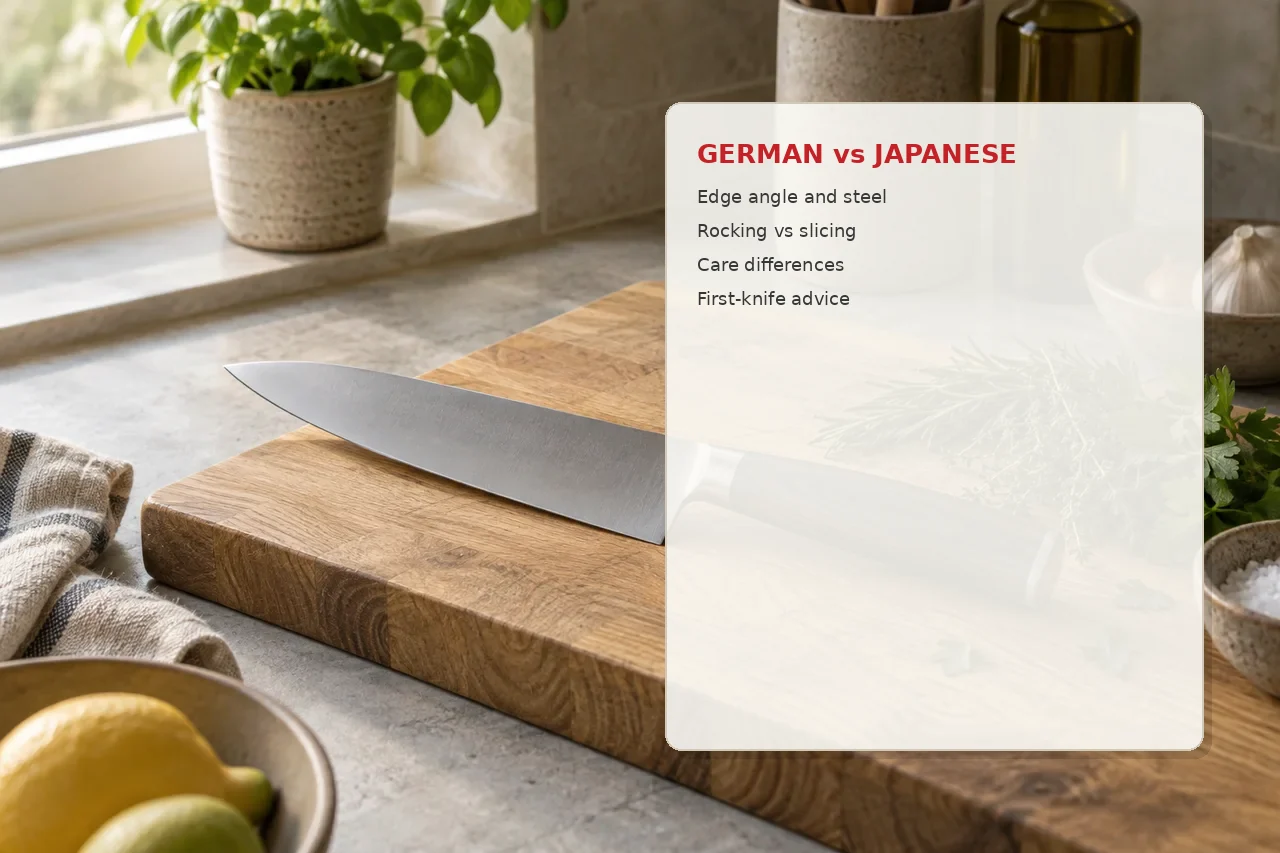
Short answer: buy a German-style chef’s knife first if you want a forgiving, heavier rocker for mixed home cooking. Choose a Japanese-style gyuto or similar if you already sharpen on stones, prefer a thinner slice, and will keep the knife off bones and frozen food.
How the two styles usually differ
These are tendencies, not laws. Modern lines blur.
| Typical German chef’s knife | Typical Japanese gyuto / chef’s knife | |
|---|---|---|
| Steel feel | Softer stainless, often about 56–58 HRC | Harder steel, often about 60–62 HRC |
| Edge angle | Wider, often roughly 14–20° per side | Narrower, often roughly 10–16° per side |
| Blade | Thicker, more curved belly for rocking | Thinner, flatter profile for push-cutting |
| Care | More forgiving of a pull-through hone; stainless resists rust better | Holds a fine edge longer; chips more if abused; carbon steels need drying |
| Best for | Garlic rocking, squash, mixed daily prep | Precise vegetable and boneless protein slicing |
Summaries of these patterns appear in cookware explainers such as The Kitchn and Serious Eats. Exact HRC and angles belong on the maker’s spec sheet for the knife you buy.
First knife advice
- One 8-inch (20 cm) chef’s knife covers most home work. Add a paring knife later.
- If you have never used a whetstone, a German stainless knife is the lower-risk start.
- If you already own a German knife and want cleaner tomato and herb cuts, a Japanese gyuto is a logical second knife, not always a replacement.
- Match the steel to your sink habits. Carbon steel takes a patina and rusts if left wet; stainless is easier to neglect safely.
For a specific German-style example we already researched, see the Wüsthof Crafter review.
What “better” means here
“Better” is edge geometry and steel hardness for a job. A harder, thinner Japanese edge can cut cleaner and then chip on a chicken bone. A tougher German edge can feel duller sooner and still survive harder chopping. Pick the failure mode you can live with.
FAQ
Are Japanese knives always sharper?
They are often ground thinner and harder, so they can feel sharper longer. Sharpening skill and cutting board choice matter as much as the passport of the steel.
Can I put either type in the dishwasher?
No. Hand wash and dry. Dishwashers dull edges and can damage handles.
Tools for this decision: Price per day of use.
Product details
Specifications below are manufacturer claims. Availability, regional versions and prices can change; check the exact model before buying.
Wüsthof Crafter series
A forged knife series distinguished by smoked-oak handles and brass rivets.
- Handle
- Smoked-oak handle and brass rivets
- Blade
- Blade forged from one piece of Wüsthof steel
- Hardness
- Manufacturer specifies 58 Rockwell hardness
- Construction
- Full bolster
Hold the exact blade size if possible. Grip, balance and willingness to maintain the wooden handle matter more than a hardness figure alone.
Manufacturer details